
What is a Webhook Gateway
A webhook gateway is a service that sits between webhook providers and consumers to manage event delivery end-to-end. It centralizes concerns like retries, rate limiting, signature verification, and routing — acting as both a reverse and forward proxy — so teams get reliable, secure webhooks without building that infrastructure themselves.
Why use a Webhook Gateway?
In today’s world of ever changing user requirements, speed is a competitive advantage. Development teams are required to move fast and deliver user value. More teams are adopting a serverless, micro-service, and service-oriented architecture to move fast. Teams are leveraging technologies like an API Gateway to consolidate duplicate tasks like authentication, rate limiting, circuit breaking etc. while product teams focus on their core business. With webhooks, teams and tech leads would need to answer the following questions:
- How can we provide a consistent infrastructure to receive events from third-party providers and route these events to one or more micro-services to handle them?
- How can we provide a consistent infrastructure to collect events from multiple backend services and send them to client endpoints?
- How can we consolidate duplicate webhook responsibilities like endpoint authentication and security, rate limiting, and endpoint failure notifications?
- Similar to API Gateways, how can we increase developer efficiency across the organisation, where webhooks become plug & play?
- How can we provide an independent infrastructure to scale to handle webhooks traffic in peak periods? See Shopify BFCM Webhooks Stats.
Your challenge is offering developers in your organisation a simple and dependable experience in the face of any webhooks complexity. A webhook gateway is a way to decouple all your microservices from your webhooks implementations. When a microservice needs to send a webhook event, they should write to the broker, the webhook gateway receives it and routes them to the right endpoint(s), whilst keeping track of everything.
We've written more on each piece of this elsewhere. If you're weighing whether you need one, start with the most common webhook gateway use cases. From there, it's worth seeing how webhook gateways for microservices handle ingress and egress routing, why they've become standard tooling in webhook gateways for platform teams, and our honest take on why teams hesitate to adopt a webhook gateway in the first place.
Architecture of Webhooks Gateway
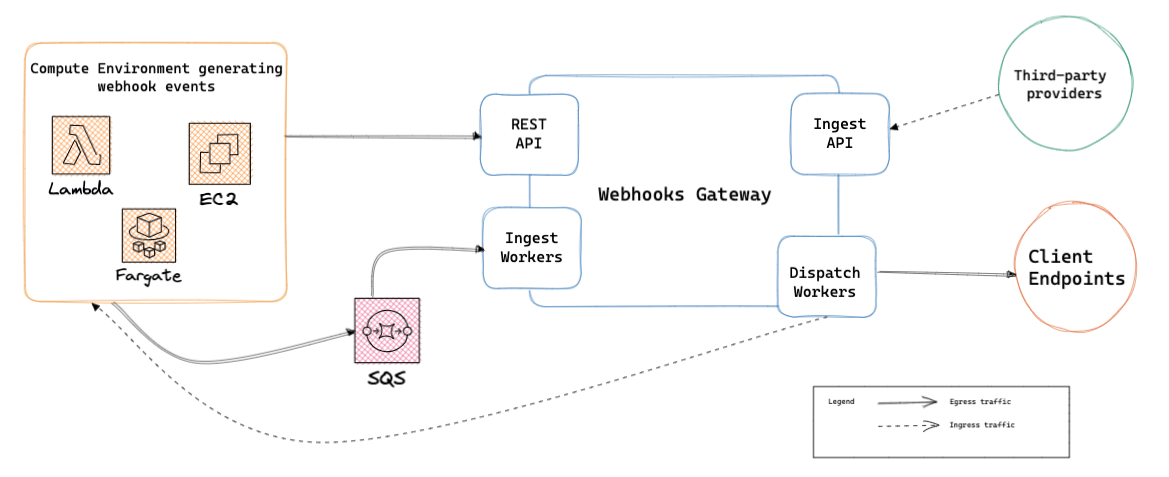
The diagram above provides an high level view of how a webhook gateway operates. We used AWS specific elements but this can be any cloud environment - Azure, GCP, Digital Ocean, etc or even On-Prem. The arrows from the left show the flow of traffic from your backend services to client endpoints on the right, and the arrows from the right show the flow of traffic from third-party providers like (stripe, twilio, etc.) to your backend services for processing.
Generally, to avoid vendor lock-in, a webhook gateway will (should) provide support for multiple broker systems like Amazon SQS, Google PubSub, Kafka etc. to allow you use the best broker for your scenario. Visit this page to learn about Convoy's internal architecture.
API Gateways vs. Webhook Gateways
Webhook gateways share similarities with API gateways
| API Gateway | Webhooks Gateway | |
|---|---|---|
| Entrypoint | Entry into the API. | Exit from the API. |
| Key Metric | Throughput & Latency | Throughput |
| API Type | Synchronous API | Asynchronous API |
| Protocols | Multiple Protocols - HTTP, Websockets, gRPC | HTTP |
| Message Format | JSON, XML & Protocol Buffers. | Mostly JSON. |
| State | Stateless | Stateful |
Conclusion
Convoy is the first ever open-source webhooks gateway to manage millions of webhooks end-to-end. If you're exploring solutions for your webhooks, we recommend starting by installing Convoy and running it in your own environment, or trying Convoy Cloud. Ready to build? You can send your first webhook event in minutes. If you have any questions or you'd like to nerd out about webhooks, feel free to join our growing community on Slack.